Our oysters that you eat are fresh, organic and sustainable.
“As I ate the oysters with their strong taste of the sea and their faint metallic taste that the cold white wine washed away, leaving only the sea taste and the succulent texture, and as I drank their cold liquid from each shell and washed it down with the crisp taste of the wine, I lost the empty feeling and began to be happy and to make plans.”
Ernest Hemmingway, A Moveable Feast
Choice Oysters was established in 2017 and was the first woman owned and third shellfish aquaculture farm in NH. over the years, I have enjoyed supplying oysters (Salty Girlz and Little Bay Littles) to individuals, distributors, local and out of state restaurants. Since about 2010, with my bachelor's in marine biology at the university of NH (UNH), I have had the opportunity to work with local farmers and conduct research on their farms and have been able to include farmers in our oyster reef restoration projects in the Great Bay-Piscataqua River system. since 2019, when COVID hit my focus has been more on including local farms in restoration efforts rather than focusing on sales.
My website showcases our research and restoration efforts that include NH farmers and other organizations and partners who’s goal it is to keep our estuaries healthy.
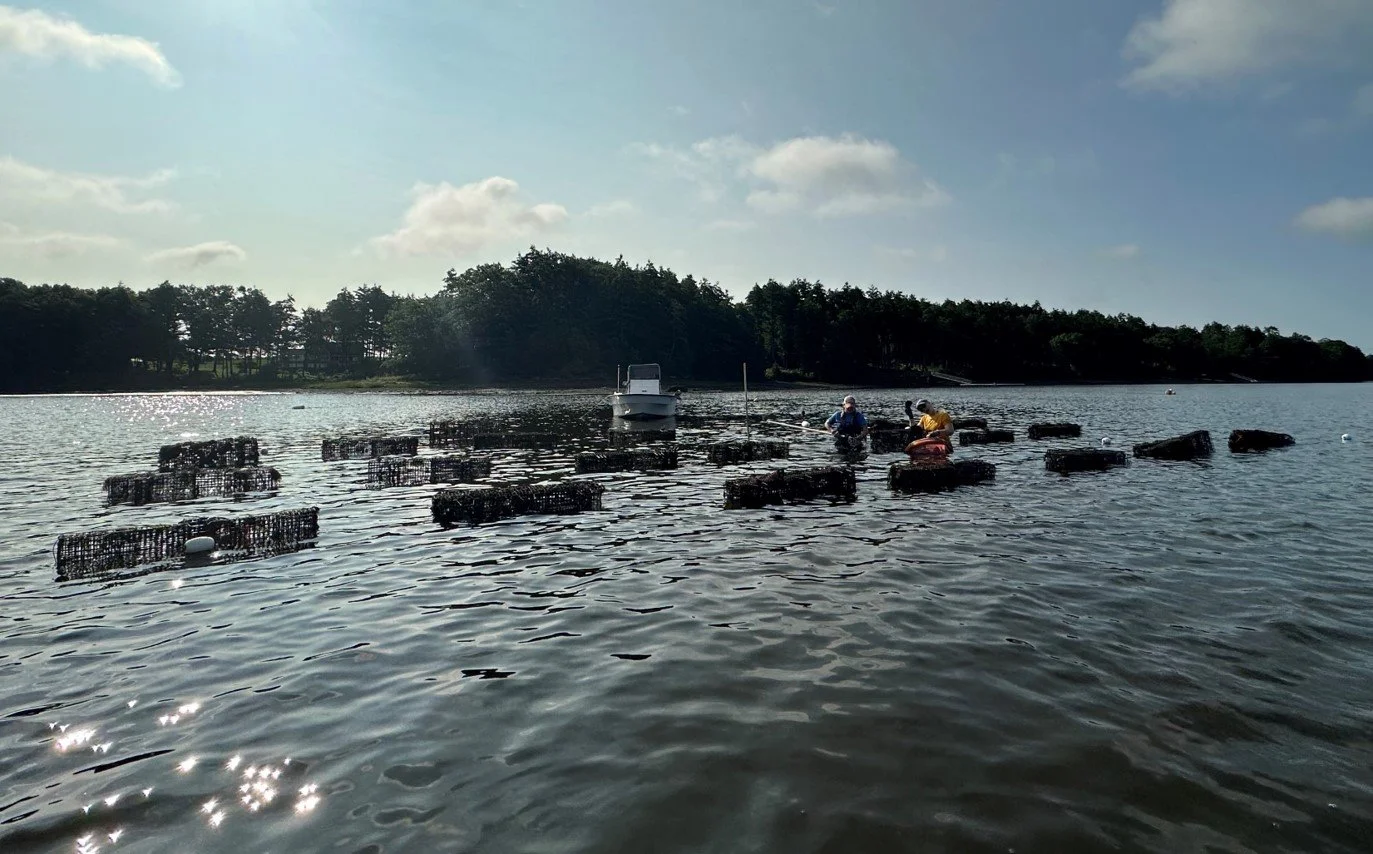
Choice Oysters Newington oyster farm
Sustainable Farming
Growing Choice Oysters... Is a labor of love, and oysters are a unique organism. Filtering approximately 30 gallons of water a day, oysters are an important species to our estuaries. Whether they are on a natural reef or held in "cages" on a farm they are still filter feeding which improves water clarity, making it possible for plants and other organisms to thrive. Natural oyster reefs and farms create habitat for lobsters, crabs and other estuarine creatures and spawning each summer populates natural intertidal and subtidal reefs throughout the bay. Living in and filtering our clean, cool, NH water, gives our oysters their unique flavor and firm texture that I know you will love!
Because oysters filter feed, there isn't a need for oysters to be fed like other forms of aquaculture. They naturally feed on phytoplankton in the water column. Pesticides and other pest control options are not needed and are never used.
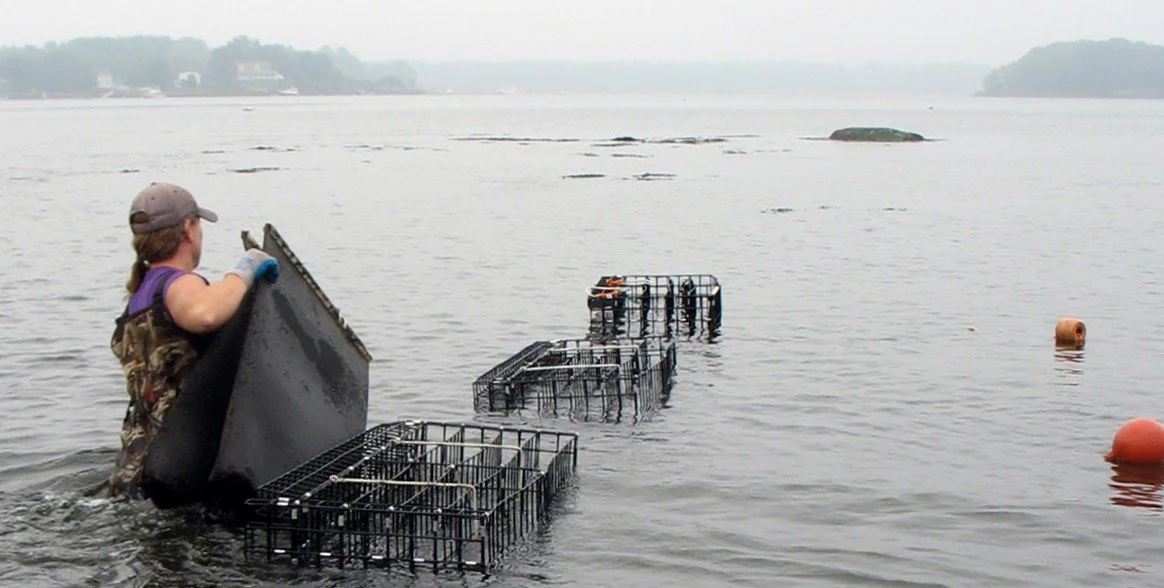
Oyster Reef Restoration
Here at Choice Oysters... we give back to the bay through oyster reef restoration projects in NH. As a farmer and a biologist at The University of NH, I have been involved in securing/permitting ~ 70 acres in the Bay to be used as restoration sites. The restoration sites are located in the Oyster River, the mouths of the Lamprey and Squamscott Rivers, and on 2 large historic, degraded oyster beds near Nannie Island and Woodman point that have seen a decline in oyster populations for years. Work includes placing oyster and clam shell on to the estuarine bottom which acts as a reef base or “hard substrate” that oyster larvae need to settle on.
Through my role at UNH, we have partnered with The Nature Conservancy to “remote set” oyster larvae (which become oyster spat-on-shell) on recycled oyster shells which are then transferred to the reef base to give the new reef a kick-start.
Oyster shells from New Hampshire's recreational harvest, local restaurants and markets are recycled and used as cultch (hard substrate) for remote set oysters to set on and these oysters are used in restoration.
Interesting Fact: All shellfish farms in the “Bay” are located in Little Bay (north). This is because Farms are not allowed to be placed on natural oyster reefs or eelgrass beds which are usually only found in Great Bay. While some areas in Little Bay are open to shellfish harvest, oysters that you pick up in Little Bay (not intertidal oysters which can be found on rocks, under rockweed along the shore) are farmed oysters that have been raised for 2-3 years by NH farmers. The farms in shallow water along the shoreline experience a loss in product each year due to recreational harvesting from shore and by boat (using tongs).
All natural reefs that are open to recreational harvest are located in Great Bay (south).
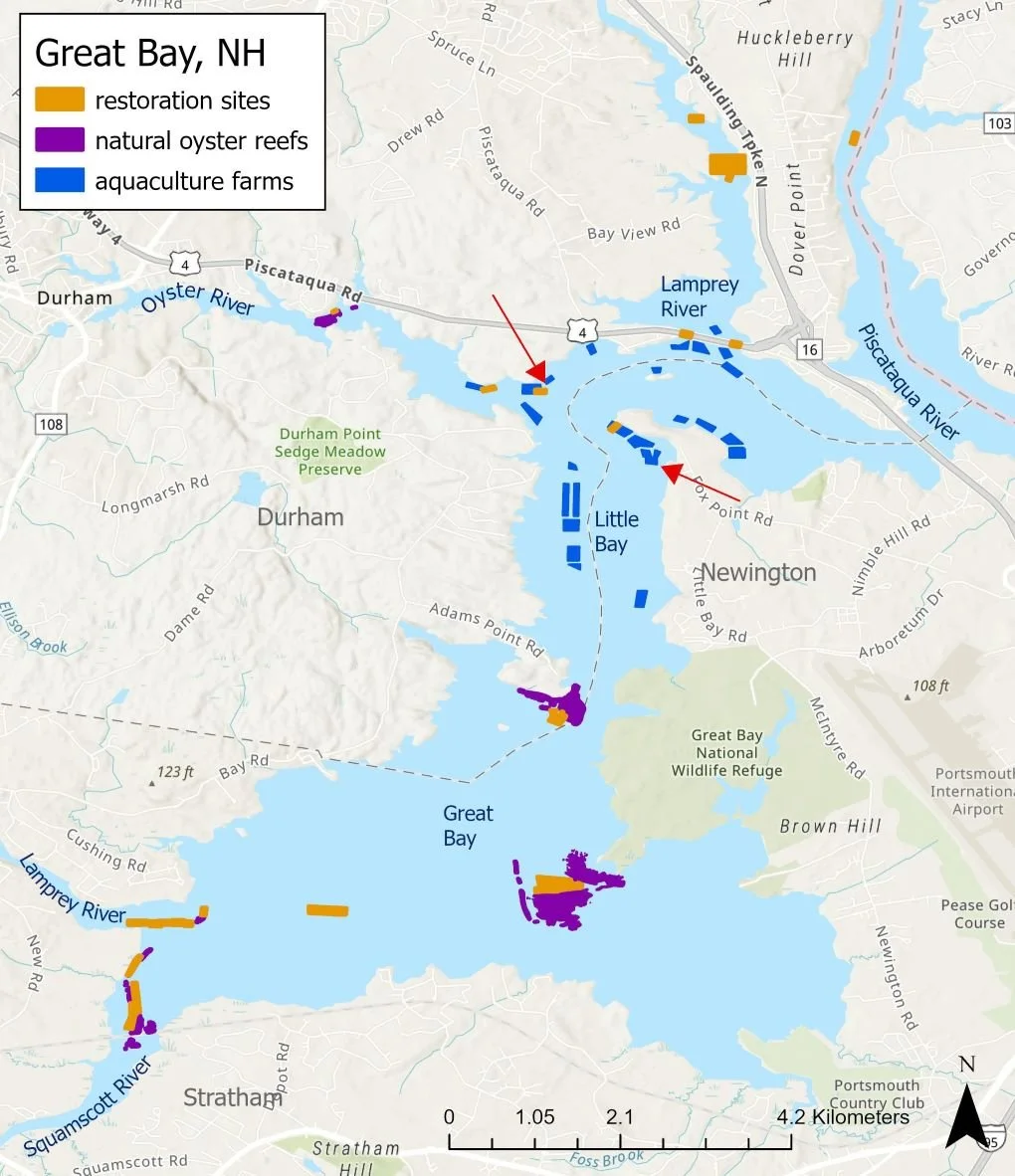
This map shows Little Bay shellfish aquaculture farms in reference to restoration sites and natural oyster reefs in the “Bay”, NH. Red arrows indicate farms owned by Choice Oysters.